Showing posts with label ACA implementation. Show all posts

Thursday, August 6, 2020

Obama's Medicaid expansion keeps gaining ground under Trump

President Donald Trump is still trying to overturn “Obamacare,” but his predecessor's health care law keeps gaining ground in places where it was once unwelcome.

Missouri voters this week approved Medicaid expansion by a 53% to 47% margin, making the conservative state the seventh to do so under Trump. The Republican president readily carried Missouri in 2016, but the Medicaid vote comes as more people have been losing workplace health insurance in a treacherous coronavirus economy.

That leaves only a dozen states opposed to using the federal-state health program for low-income people as a vehicle for covering more adults, mainly people in jobs that don't provide health care. Medicaid expansion is a central feature of former President Barack Obama's Affordable Care Act, covering about 12 million people, while nearly 10 million others get subsidized private insurance.

If present trends continue, it's only a matter of time until all states expand Medicaid, acknowledged Brian Blase, a former health care adviser in the Trump White House, who remains opposed to the expansion.

“Medicaid expansion is terrible policy, but it is attractive to states because it's almost all federal spending and the insurance companies and hospitals get lots of dollars when a state expands Medicaid,” he said.

The federal government pays 90% of the cost of covering people through the expansion, a much higher matching share than for low-income disabled and elderly people traditionally covered by Medicaid. Blase argues that's an incentive to waste federal dollars. Before the ACA most low-income adults couldn't get Medicaid unless they were caring for children.

“There's lots of political pressure to expand,” said Blase. “Eventually all states are going to expand unless the enhanced (federal) match rate changes.”

Voters in another conservative state — Oklahoma — approved a Medicaid expansion earlier this year, although the margin was much closer than in Missouri. Of the seven states that have expanded Medicaid in the Trump years, six have done so by referendum, said Rachel Garfield, a senior policy expert with the nonpartisan Kaiser Family Foundation.

“This is an indication that there is large popular support for providing health care coverage for low-income people, and it is quite possible that this support has increased given what's going on with the pandemic,” Garfield said.

The six states where voters have approved Medicaid expansion in the Trump years are Idaho, Maine, Missouri, Nebraska, Oklahoma and Utah. In Virginia, the legislature passed a Medicaid expansion after Democrats made political gains.

“That has been an interesting feature of the Trump administration, that momentum among the states to expand Medicaid has not slowed down,” said Jesse Cross-Call, a policy expert with the Center on Budget and Policy Priorities, which advocates for low-income people.

Trump is trying to persuade the Supreme Court to toss out “Obamacare,” but as long as it remains the law his administration has to carry out expansions that states approve. Democratic presidential candidate Joe Biden would ask Congress to provide coverage where states have refused.

In Missouri, support for Medicaid expansion in cities and suburbs overcame opposition in rural communities. Supporters used the coronavirus pandemic to highlight the need for health care, especially in the wake of joblessness and loss of employer-provided insurance. The Missouri Chamber of Commerce and Industry, one of the state’s most influential business groups, also pushed for expansion as a way of helping the economy recover after COVID-19.

Cindy Mann, who ran Medicaid under Obama, argues that there's also a strong fairness argument for expansion. About 4.5 million poor adults live in states that have resisted expanding Medicaid. But because of the way the Obama health law is written, they don't qualify for subsidized private insurance through marketplaces like HealthCare.gov and they're stuck in a coverage gap.

“Those people have no access to coverage,” said Mann, now with the Manatt Health consultancy. “Those are a lot of the so-called essential workers, if we think about it through the COVID lens. It's a really inequitable story and one that increasingly can't be tolerated by the public.”

No other state referendum votes on Medicaid expansion are scheduled this political season. But Mann expects the debate will percolate through legislative elections in the 12 states, mainly in the South, that have refused. The biggest prizes are Texas, Florida and Georgia.

“Now they are surrounded by states that have expanded,” she said.

source

Tuesday, April 11, 2017

ACA individual insurance market is improving, but still fragile

Despite claims from President Donald Trump and other Congressional Republican leaders that the Affordable Care Act's individual insurance market is in a “death spiral,” that market is actually improving, according to one analysis.

Ratings firm S&P Global looked at the financial performance of 32 Blue Cross and Blue Shield companies that have sold coverage in the individual insurance market since the ACA took effect in 2014.

It found that the medical-loss ratio, which represents the amount of collected premiums spent on medical claims, improved significantly in 2016 for most Blues insurers, which have struggled with the market in the first couple of years. Last year, insurance premiums exceeded medical care costs for the majority of the Blues plans studied.

“We are seeing the first signs in 2016 that this market could be manageable for most health insurers,” the report stated.

Barring any major legislative changes, S&P analysts predict many of the Blues plans will get close to breaking even in their individual market business this year, and more will record a profit in 2018. But that could change if the Trump administration makes any major legislative changes to the healthcare law.

“The market is still fragile,” said Deep Banerjee, S&P analyst and lead author of the report.

The findings are good news for a market that has been plagued with negative headlines and enrollment declines.

Enrollment in the ACA's exchanges fell to 12.2 million in 2017 from 12.7 million the year before. Premiums rose by double-digits on average in 2017. Health insurers have threatened stop selling insurance plans in the individual market next year without a sign that it will stabilize and become profitable soon.

Some have already pulled the plug: Aetna, UnitedHealth Group and Humana, have exited or scaled back their participation in the individual insurance market. And last week, two of Iowa's largest insurers—Wellmark Blue Cross and Blue Shield and Aetna—announced they will no longer offer ACA-compliant individual coverage in the state in 2018, citing financial losses and uncertainty about future insurance regulations.

But many of the Blues insurers have stuck around. They slowly figured out the market, adjusted insurance premiums and tweaked provider networks.

And now they are seeing results: According to the report, the weighted average medical loss ratio, or MLR, for the Blues plans studied was 92% in 2016, down from 106% in 2015 and 102% in 2014. That means for the first time since 2014, the plans collected more money in premiums than they spent on medical claims in 2016.

But while the “individual market is not in a 'death spiral,' it isn't on stable footing either,” the S&P report said.

The Trump administration has yet to address insurers' most pressing concerns about the availability of cost-sharing reductions and the enforcement of the mandate that consumers purchase coverage. The S&P report also notes that enforcement of the ACA's special enrollment periods and enrollment outreach are crucial to the stability of the market.

“If insurers are uneasy regarding the future of the market, they may have to decide between adding an "uncertainty buffer" to their pricing or--worst case--exiting the exchanges altogether,” the S&P report said.
 

source

Wednesday, September 14, 2016

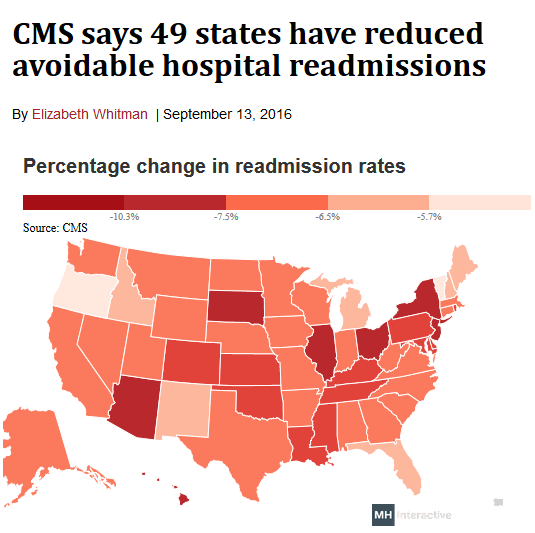
CMS says 49 states have reduced avoidable hospital readmissions

Every state in the U.S. but Vermont has reduced its avoidable hospital readmission rates since 2010, new data released Tuesday by the CMS show. These improvements follow the implementation of various CMS programs and initiatives to improve the quality of care, chief among them the Hospital Readmissions Reduction Program.


The overall decrease in readmission rates translated to about 100,000 hospital readmissions avoided for Medicare beneficiaries in 2015 alone, and some 565,000 readmissions since 2010.

“The Hospital Readmissions Reduction Program is just one part of the Administration's broader strategy to reform the health care system by paying providers for what works, unlocking health care data, and finding new ways to coordinate and integrate care to improve quality,” wrote Dr. Patrick Conway, principal deputy administrator and chief medical officer for CMS, and Tim Gronniger, the deputy chief of staff for CMS, in a blog post Tuesday announcing the new data. “The data show that these efforts are working,” they added.

The one state where Medicare's 30-day hospital readmission rate rose was Vermont, from 15.3% in 2010 to 15.4% in 2015. CMS described this as “virtually unchanged.” Of the states where readmissions fell, 43 saw decreases of more than 5%, while in 11 states rates fell by more than 10%. Readmission rates also dropped in Washington, D.C.

Previously released data showed that national readmission rates fell 8% from 2010 to 2015. In a 2008 report to Congress, the Medicare Payment Advisory Commission estimated that such readmissions cost Medicare as much as $12 billion annually.

The Hospital Readmissions Reduction Program was created under the Affordable Care Act. It took effect October 1, 2012, cutting Medicare payments to hospitals with excess readmissions for a handful of conditions. For the coming fiscal year, those cuts are capped at 3%.
The program is rooted in the idea that unnecessary readmissions are a sign of poor quality care, and that by devising the proper financial incentives, CMS can encourage hospitals to prevent excessive returns through better follow-up care after patients are discharged.

The number of applicable conditions in the program has grown steadily since 2012, with coronary artery bypass graft surgery as the most recent addition. Starting in October, with the new fiscal year, hospitals will be held accountable for readmissions for that condition and five others: heart attacks, heart failure, pneumonia, chronic lung disease, and hip and lung replacements.

The CMS estimates that it will penalize more than 2,500 hospitals -- more than half those in the country -- for excess readmissions in the coming fiscal year. Those penalties will save the agency about $538 million, up $108 million from the year before. It expects to spend about $746 million on inpatient hospital services in the coming fiscal year.

source

Tuesday, July 5, 2016

Kansas hospitals are hurting, at risk


Those standing firm against expanding Medicaid in Kansas have their reasons, however politically contrived. But, as predicted, their inaction is harming the health care industry, which represents 9 percent of the state’s economy.

Those standing firm against expanding Medicaid in Kansas have their reasons, however politically contrived. But, as predicted, their inaction is harming the health care industry, which represents 9 percent of the state’s economy.

Gov. Sam Brownback’s 4 percent cut to Medicaid reimbursement rates as of July 1 only increases the financial stress, by further shorting health care providers already suffering from federal payment reductions. As the cut to mostly urban physicians, dentists, hospitals, nursing homes and others frees up $38 million to help balance the state budget, it fuels worries that providers will accept fewer Medicaid patients and that access to care will be jeopardized for the very poor and those with disabilities.

How many jobs will be trimmed and providers hobbled before the governor and his GOP legislative allies are persuaded that Kansas must join the 32 states that have expanded Medicaid under the Affordable Care Act? Might KanCare, Brownback’s signature 2013 privatization of Medicaid, be stronger if the state’s health care system hadn’t forfeited the $1.2 billion in federal funding since 2014 that would have accompanied Medicaid expansion?

Now, 1 in 3 rural Kansas hospitals is at risk of going the way of Independence’s Mercy Hospital, which closed last fall amid mounting financial losses. Though it’s unclear what would have been the hospital’s salvation, Medicaid expansion would have brought it an additional $1.7 million a year.

Last week Wichita-based Via Christi Health announced it would eliminate 150 positions while adding 80 bedside nursing jobs.

When asked about the effect of Medicaid cuts and lack of expansion, interim CEO Todd Conklin told The Eagle in a statement: “Our state’s decision not to expand KanCare continues to have a significant negative impact on Kansas health systems, especially those that like Via Christi serve this important part of our communities.”

Via Christi estimates the state’s refusal to expand Medicaid is costing it $14 million per year and the state’s Medicaid rate cut will mean a loss of $4.3 million more a year.

So the situation is even worse than the “the worst of both worlds” that Via Christi’s then-CEO Jeff Korsmo predicted three years ago in The Eagle: “providing more uncompensated care for Kansans still not eligible for Medicaid while receiving less money from the federal government to cover these costs.”

State lawmakers have heard all this again and again, including in packed and emotional House hearings last year. The Kansas Hospital Association has proposed an expansion plan it calls “beyond budget neutral,” in that the state’s cost of $57.5 million in 2017 would be offset by additional revenues and savings of about $159.4 million.

If state leaders are uninterested in enabling 150,000 Kansans to become insured because it would mean “expanding Obamacare,” to use the governor’s words from last week, how long can they avert their eyes from the consequences for the health care industry and overall state economy?

source

Read more here: http://www.kansas.com/opinion/editorials/article84498007.html#storylink=cpy


Read more here: http://www.kansas.com/opinion/editorials/article84498007.html#storylink=cpy

Thursday, May 5, 2016

More Red States Embrace Obamacare, As Long As You Don’t Call It That

Republicans are tying themselves in knots over health care for the poor.

Presidential candidates and other national politicians throw around a lot of rhetoric about health care reform, but the real action is happening in conservative state legislatures across the country.

Red state governors and lawmakers are deciding what health care for low-income people and those with disabilities delivered through Medicaid, the joint federal-state health benefit program, will look like in the post-Obamacare era. 

“This, at this point, is largely a fight within the Republican Party,” said Joan Alker, executive director for the Center for Children and Families at Georgetown University, who is an expert on Medicaid issues.

In some cases, Republicans have concocted pretty convoluted ways to do Obamacare without saying they’re doing Obamacare, to get other Republicans to go along.

The passage of the Affordable Care Act in 2010 and a Supreme Court decision two years later affirming states’ rights to refuse to participate in the law’s Medicaid expansion triggered this fight. 

The ACA called for Medicaid to be available to anyone earning up to 133 percent of the federal poverty level, or $16,000 for a single person, and provided full federal funding from 2014 through 2016, after which Washington gradually contributes less until 2021 and future years, when states will pay 10 percent of the costs. The federal government pays an average of 57 percent of other Medicaid expenses.

Thirty-one states and the District of Columbia have expanded Medicaid, which has been a key contributor to the historic reduction in the uninsured rate since 2013.

Democratic states quickly took up this arrangement, which enabled them to advance the cause of covering the uninsured at little cost to their budgets. So did states with divided government, including Kentucky and New Jersey, and even some GOP-led states like Nevada and North Dakota

Republican interest in participating in Medicaid expansion grew after Arkansas’ divided government won federal approval for a privatized model. After that, states with Republican leadership, such as Michigan and Ohio, joined in. 

This year, expansions, contractions, cuts and sweeping reforms are on the docket in states like Alabama, Oklahoma and South Dakota.

In those places and elsewhere, ideology about the role of government and about the Affordable Care Act itself is running into practical realities about access to health care and the availability of federal dollars.

South Dakota: A ‘Win-Win-Win’

When the opportunity first presented itself in 2012, South Dakota Gov. Dennis Daugaard (R) rejected Medicaid expansion, portraying it as a handout to “able-bodied” people who didn’t want to work.
Even when he changed his tune last year and found a way to support expansion, Daugaard expressed “hate” at the idea of making people dependent on the government.

But what Daugaard saw is that taking federal money to expand Medicaid and cover more uninsured in South Dakota also would allow the state to reduce spending on other programs, and to address longstanding problems with access and quality of health care for American Indians in the state who use the federal Indian Health Service. 

Federal authorities have cleared the plan, and the state government already is preparing to carry it out

“It is a unique opportunity, and it really does appear to be a win-win-win,” said Carole South-Winter, a professor who studies health policy at the University of South Dakota in Vermillion.

The South Dakota legislature ended its session without considering the expansion, but the state’s top health official says Daugaard may call them back for a special session

Despite conservative opposition to Obamacare, legislators are open to the proposal, which Daugaard promises will cost the state nothing, South-Winter said. “If it works, it’s genius.”

Oklahoma: Expansion By Contraction

Anyone who needs a reminder of the wacky politics of Obamacare need only consider this: In order to sell a proposed Medicaid expansion in the Sooner State, the administration of Gov. Mary Fallin (R) is framing it as a contraction of the program. 

“The governor and others have gone from being total refuseniks on the Affordable Care Act to saying, ‘Yeah, just don’t call it that,’” said David Blatt, executive director of the Tulsa-based Oklahoma Policy Institute. “This is a really, really high-stakes gamble.”

Here’s how that works: The Oklahoma Health Care Authority wants legislative approval for a plan that would move some pregnant women and children currently on Medicaid onto the federally subsidized health insurance exchanges created by the Affordable Care Act. 

At the same time, they would open up Medicaid to more poor adults through the state’s Insure Oklahoma program. The proposal also would create new financial requirements for Medicaid beneficiaries. The net result would be fewer Oklahomans on Medicaid, and less spending by the state government.
A slide from the Oklahoma Health Care Authority’s Medicaid 
reform proposal, which shows the program shrinking even as
more people gain health coverage overall.

Oklahoma is one of several states facing budget shortfalls this year because of low oil prices.
Since Medicaid is one of the largest items in the budget, it’s a target for cuts. But simply slashing payments to medical providers would be difficult. The state proposed cutting fees by a quarter, which the health care industry contends would force hospitals and nursing homes out of business and drive doctors to stop treating Medicaid patients.

Another solution is the Medicaid expansion and reform, and Republican lawmakers have warmed up to it, Blatt said.

The main obstacle at this point isn’t the Obamacare question, Blatt said, but disagreement among legislators about another component of the plan: a $100 million increase in taxes on tobacco products.

Arkansas: Trickery Preserves Expansion

Gov. Asa Hutchinson (R) kept his views of the state’s privatized Medicaid expansion to himself while running for office in 2014. The so-called private option, which uses Medicaid funds to pay for private insurance, was the creation of Hutchinson’s Democratic predecessor, Mike Beebe, and the GOP-led legislature in 2013.

But there are enough staunchly anti-Obamacare lawmakers in that body that the fight must be refought every year, and it’s especially tough because the legislature’s rules require a 75 percent majority to pass spending bills. 

Despite his earlier recalcitrance, Hutchinson stepped up to protect and reform the private option — which he rebranded as Arkansas Works — this year, teaming with Republican and Democratic legislators to keep the program going.
AP Photo/Gareth Patterson
Arkansas Gov. Asa Hutchinson (R) speaks during a town hall in 
Conway in favor of keeping the state's hybrid Medicaid
expansion in place.

Most remarkable, however, was how the final bill became law. In order to overcome the rump group of conservatives defying the majority, Hutchinson came up with an unorthodox plan.

Republicans opposed to the expansion were permitted to add a provision that would repeal it to a big, must-pass budget bill. Supporters of Medicaid expansion had to vote in favor of the legislation, including the repeal language. 

Then Hutchinson used his line-item veto authority to remove that one part of the bill and keep expansion in place, while enacting the rest of the budget.

Democratic legislators were so nervous, one worried what would happen if Hutchinson died before putting pen to paper. And the plan hinged on Republican opponents being satisfied by passing repeal knowing it would never happen. 

Somehow, this worked. And they’ll probably have to do it all over again next year. 

Ohio: Big Changes Need Obama’s OK

Gov. John Kasich (R) has gotten a lot of flack from conservatives for circumventing state legislature to expand Medicaid in 2013, and this supposedly pro-Obamacare move dogged him during his failed pursuit of the Republican presidential nomination. 

This year, Kasich signed legislation favored by Ohio conservatives that would make some significant changes to how the state runs Medicaid. 

Modeled in part on the Healthy Indiana Plan and Medicaid expansion that won federal approval last year, the Healthy Ohio Program would require beneficiaries to enroll in private insurance, pay a portion of their incomes for the benefits and more money for medical care than under traditional Medicaid. That would include people with incomes below poverty level. Elderly Ohioans, people with disabilities, and other more vulnerable beneficiaries would be exempt.

Creating new financial obligations for Medicaid enrollees would result in fewer people with health coverage, say critics, including U.S. Sen. Sherrod Brown (D-Ohio). 

And the plan also would take away coverage from a slew of low-income groups, including breast and cervical cancer patients, and children when they turn 18. The law also would end the normal Medicaid practice of “retroactive eligibility,” which allows the program to pay for recent medical bills for people deemed to qualify for the program.

“The process that’s envisioned under this waiver would result in tens of thousands of people losing coverage,” said John Corlett, president of the Center for Community Solutions in Cleveland, who ran Ohio’s Medicaid program when Democrat Ted Strickland was governor.

The strictest parts of the plan face tough hurdles at the federal level, however. 

No state has ever been allowed to charge money for Medicaid to people who make less than poverty wages, and Health and Human Services Secretary Sylvia Burwell in the past has expressed skepticism about ending retroactive eligibility. 

Alabama: Expansion Hopes Dashed

A task force hand-picked by Gov. Robert Bentley (R) recommended Alabama expand Medicaid last year, and Bentley himself even expressed a new openness to the idea at the time. 

And that’s as far as Alabama came to extending coverage to its poorest uninsured residents. What’s more, budget problems might force cutbacks for current Medicaid enrollees this year.

“He’s facing a legislature that’s controlled by these very, very small-government, more libertarian-minded folks that aren’t going to agree to anything,” said David Becker, a health policy professor at the University of Alabama at Birmingham.

Medicaid expansion has broken through in other conservative states because a governor or group of legislators fought hard for it, and because of pressure from health care interests. That’s not happening in Alabama, Becker said.

“A weak governor who’s kind of wishy-washy on his level of support for doing this hasn’t been helpful. And on the Democratic side, there’s just nothing there,” Becker said.
 
Reuters/Marvin Gentry
Alabama Gov. Robert Bentley (R) needs more money to keep 
Medicaid afloat, but he’s also mired in a sex scandal.

Instead of expansion, Alabama instead is trying to close an $85 million hole in its budget after it requested $100 million from the legislature and got just $15 million. A last-ditch attempt to divert a portion of the state’s settlement with BP over the 2010 Gulf of Mexico oil spill to Medicaid failed, and the legislative session is nearly over.

Without more money from resistant lawmakers, Bentley says Medicaid will have to cut services, including prescription drug coverage for adults, and reduce what it pays medical providers, even as the state continues implementing a prior round of reforms to the program. 

Meanwhile, some legislators want to impeach Bentley over a sex scandal that came to light this year.

Elsewhere

There’s been plenty of action on Medicaid in other states, too.
Louisiana expanded Medicaid under new Democratic Gov. John Bel Edwards. New Hampshire extended its Medicaid expansion after heated debate. Iowa implemented a controversial privatization plan. Kentucky Gov. Matt Bevin (R) wants to apply a version of Indiana’s landmark reforms to his state’s expanded Medicaid program. New Mexico is eyeing payment cuts for doctors and hospitals. And West Virginia may not be able to pay medical providers on time due to budget problem

 source

Wednesday, October 8, 2014

Obamacare Is Making a Difference, But Here's What We Must Tackle Next

Wendell Potter

Although there is no shortage of critics of the Affordable Care Act -- on the far left as well as the right -- it's hard to dispute that the law has benefited millions of Americans. And not just those who have become newly insured over the past year.

President Barack Obama cited some of the impressive statistics last Thursday, the day after the one-year anniversary of the turbulent debut of the Obamacare-created online health insurance exchanges.

"In just the last year, we've reduced the share of uninsured Americans by 26 percent," he said. "That means one in four uninsured Americans -- about 10 million people -- have gained the financial security of health insurance in less than one year."

Approximately 8 million people were finally able to sign up for coverage on the exchanges after the many technical problems were fixed. Many others were able to enroll in health plans on private exchanges or by working directly with an insurance company or agent. As a consequence, the rate of uninsured Americans dropped from 21 percent in September 2013 to 16.3 percent this past April.

Even though open enrollment for the Obamacare exchanges ended in April, people have still been joining the ranks of the insured since then. In fact, the Congressional Budget Office estimates that the number of newly insured Americans will grow to 12 million by the end of this year.

A significant percentage of those folks were not able to find affordable coverage in the past, and many were not able to buy health insurance at any price because of insurance industry business practices that were outlawed by the ACA. Before Obamacare, insurance companies were able to declare you "uninsurable" if you had a preexisting condition, even conditions you might have been born with.

During the months that health care reform was being debated in Washington, I met many young people who told me they had not been able to buy an insurance policy because of congenital heart defects and other conditions they had had since birth.

Now they can.

That provision and other parts of Obamacare that force insurance companies to be more consumer-friendly benefit all of us, but those sections of the law are rarely mentioned these days, probably because many of them went into effect long before the exchanges were up and running. Here's a partial list:

Insurers can no longer "rescind" our policies when we get sick just to avoid paying our medical expenses;
They must allow our children to stay on our policies until they turn 26 if they can't find jobs that offer coverage;

They can't devote more than 20 percent of our premium dollars to overhead and profits;

They can no longer charge women more than men; and

They can't charge older folks more than three times as much as they charge young people for the exact same policy.

The law also benefits seniors on Medicare by closing the donut hole in the prescription drug benefit and by covering preventive care, including screenings, and it is saving the Medicare program billions of dollars by gradually reducing the extra amounts the government has been paying private insurers to participate in the Medicare Advantage program.

All that said, the law falls short in many ways. While it is reducing the rate of uninsured Americans, it doesn't get us anywhere close enough to the universal coverage that residents of other developed countries enjoy. While the ACA will cut the number of uninsured by half in the coming years, the CBO estimates that 31 million of us will still be uninsured in 2024.

Many of the newly insured are also finding that their choices of health care providers is severely limited in some of the health plans being offered on the exchanges. "Narrow networks" are not new -- they were common in the managed care plans of the 1990s -- but insurers gradually began to broaden their networks after widespread complaints. Now they're making a comeback.

The ACA also allows insurers to sell plans with very high deductibles. They can appear at first glance to be good deals because their premiums generally are lower than plans with more modest deductibles. But many people who enroll in high-deductible plans find out after they get sick or injured that they can't afford to pay their share of their medical bills. Although the ACA does put a limit on out-of-pocket expenses, it still will not prevent many insured families from filing for bankruptcy after a serious illness.

And while the law apparently is helping to keep medical costs in check, it doesn't go far enough. We still spend more per capita on health care than any other country. In that sense, I agree with my former colleagues in the insurance industry: The law doesn't do enough to address the "real cost drivers" of medical inflation. That will require taking on the hospital companies, physician organizations and drug makers in ways the White House and members of both parties in Congress were not willing to do in 2009 because of the political clout they have in Washington. Consequently, much more reform will have to be undertaken in years to come.

source

Friday, September 12, 2014

Maine Voices: Maine hospitals suffering because of state’s refusal to expand Medicaid

They’re losing money at a time when extra federal funds could support 4,400 jobs and lift the economy.

Maine’s hospitals got a financial checkup recently, and – thanks in part to some malpractice by state policymakers – the prognosis is bleak: For the 12-month period ending March 31, 2014, the hospitals collectively lost money, with an aggregate operating margin of minus 0.3 percent.

The analysis, prepared by the Maine Hospital Association for legislative candidates, also found that the number of Maine hospitals in the red for 2013 was double what it is in a typical year.
Health care is a critical component of Maine’s economy. In fact, hospitals are the largest employers in seven counties.

Part of the recent contraction could be a result of too much success. Maine’s hospitals are working hard at one of the core goals of health care reform: keeping people well with preventive and better-coordinated care, and keeping them out of the hospitals. While good for individuals and a brake on health care cost growth, fewer people in the hospital will inevitably put a dent in the bottom line for some hospitals.

But there’s more to this story.

The U.S. health care system is splitting in two. In the states that accepted federal funds to insure more low-income people through Medicaid, hospitals have received a welcome shot in the arm.

One multi-state health system, Tenet Hospital, reported that hospitals in states that expanded Medicaid have experienced across-the-board increases in patient volumes, surgeries and outpatient visits. These hospitals also saw a bump in emergency admissions – unsurprising, given that some working poor men and women have been uninsured for years and have pent-up health needs.

At the same time, uninsured admissions were halved in expansion states. This is important, because when patients cannot pay because they are uninsured, hospitals still must treat them – and the “free care” falls on the red side of hospital ledgers.

Hospitals in states that have refused federal Medicaid funds, including Maine, have received no such boost. The Robert Wood Johnson Foundation estimates that those states will squander more than $420 billion through 2022 – funds that would flow into their state economies, boosting hospital revenues and bringing thousands of health care jobs.

The Maine Center for Economic Policy estimates that the $338 million in federal funds that would be directed to Maine each year would add half a billion dollars annually to Maine’s economy and support 4,400 jobs staffing hospitals and caring for the newly insured.

Insurance coverage has increased most in states that expanded Medicaid and also set up their own marketplaces for private insurance. Among those states, the highest percentage-point improvements in coverage were in Arkansas (10.1 percent) and Kentucky (8.5 percent), while the average was 4.4 percent.

By contrast, states that didn’t expand Medicaid experienced a 2.4-percentage-point increase in coverage, largely because of the availability of more affordable private insurance coverage through health care marketplaces, whether state-run or federal. Maine, which is relying on the federal marketplace, fared slightly better, with a 2.8-percentage-point increase in coverage, partially because of coordinated enrollment efforts by a wide range of community organizations.

If Maine had expanded Medicaid in 2014, the level of coverage would have been greater. Instead, Maine’s hospitals continue to pick up the tab for treating thousands of people who would be eligible for coverage but remain uninsured because of Maine’s refusal to accept federal funds.

Experience from other states clearly shows that these funds could pay for needed care and boost operating margins at hospitals throughout Maine. Many rural counties, where the percentage of uninsured is higher than average, would benefit most from the new jobs tied to the health care funds.

While Maine’s governor resists, some of his fellow critics of the Affordable Care Act are recognizing their error. Republican Gov. Matt Mead of Wyoming, for instance, recently began meeting with federal officials to talk about what expanding Medicaid in Wyoming might look like.

“We’re handing (out) $200 million in free care just in Wyoming,” Mead said recently. “I contrast it with, I think it’s about $60 million this year that if we were in Medicaid, we would have received.” He plans to present his findings to the Wyoming Legislature when it reconvenes.

As a transformation in health care sweeps the nation, Maine is trapped in political amber, with many uninsured residents postponing care and hospitals losing money on those who do seek treatment. It’s unfortunate that, unlike Gov. Mead in Wyoming, some policymakers in Maine still won’t let the facts – and the numbers – convince them to remove their ideological blinders.

Friday, July 18, 2014

New challenge for Obamacare: Enrollees who don’t understand their insurance plans

Nine months after Americans began signing up for health insurance under the Affordable Care Act, a challenging new phase is emerging as confused enrollees clamor for help in understanding their coverage.
Nonprofit organizations across the country are being swamped by consumers with questions. Many are low-income, have never had insurance and have little knowledge of the health-care system. The rampant confusion poses a potential hurdle for the success of the health law: If many Americans don’t understand how health insurance works, that could hurt their ability to use their benefits — or to keep their coverage altogether.

Community organizations are scrambling to keep up with the larger-than-anticipated demand, but they are stretched thin. A federal program to help consumers has also run out of money.

“We are hearing this in probably every state that we work in,” said Christine Barber, a senior policy analyst with Community Catalyst, a Boston-based advocacy organization that works with community groups in more than 40 states. “ ‘Okay, I have my card. What do I do now?’ ”

Health insurance, with its jargon and complicated fee structure, has long been confusing for many consumers, but experts say the literacy gap poses an especially big problem now. Before the opening of the marketplaces, people buying coverage on their own tended to be individuals with higher incomes and more familiarity with how insurance works.

See fact sheets:
Beyond that, continuing technical problems with the federal health insurance exchange and state exchanges mean some enrollees still have not gotten insurance cards or are not getting billed properly. That adds to the workload of nonprofits and insurers.

“So what you’ve got is an insurance industry that did not do a good job in gearing up for a population that has never had health insurance before, an Obama administration that did a horrible job on the back end, resulting in a flood of calls to insurer call centers, and a population that is low-income and is not health-insurance literate. Put those things in a bag and you’ve got a problem,” said Robert Laszewski, a health industry consultant who has been critical of the Affordable Care Act.

Tasha Bradley, a spokeswoman for the Department of Health and Human Services said, “We are focused on continuing the work we began during open enrollment of educating consumers about their new health insurance coverage.”

At a Silver Spring health clinic, Rebecca Wener spends most of her time helping clients figure out their new plans. Julio Herrera, 63, a construction worker, bought what he thought would be the most affordable plan when he enrolled through Maryland’s new insurance exchange this spring.

But he does not understand why he is getting charged for hospital bills when he already pays the insurance company every month. And he did not grasp this thing — a deductible — that was $4,000.

“If there is one concept that people don’t understand, it’s the deductible,” said Wener, a specially trained enrollment worker at Community Clinic, a nonprofit group that helps low-income Maryland residents.
“That’s been a really huge thing. And the very cheapest plans have very big deductibles.” (The deductible is the amount consumers must pay in medical costs every year before insurance kicks in.)

Organizations that helped people sign up for insurance are being swamped by consumers returning for help. It’s “the boomerang effect,” said Karen Pollitz, a senior fellow at the Kaiser Family Foundation. Confused consumers who cannot find help elsewhere return to the people and places they trust, she said.

The foundation surveyed an estimated 4,400 such consumer assistance programs shortly after sign-ups ended in the spring. Ninety percent of those programs had been recontacted by consumers and 44 percent had seen people who did not understand how to use insurance, according to a foundation report released Tuesday.

Demand for help from consumers has been so overwhelming at the Pennsylvania Health Access Network, a statewide coalition working to expand insurance coverage, is launching special seminars for consumers later this summer, said Antoinette Kraus, the coalition’s director.

Language and cultural barriers are adding to the confusion. Many clients also struggle to read and write in their native language, predominantly Spanish, making for a steeper learning curve, said Elizabeth Colvin, director of Insure Central Texas, an Austin-based nonprofit working on enrollment. The majority of the 5,647 residents the group enrolled had never had insurance before, she said.

And health insurance is not an intuitive concept.

Until this year, Dibekulu Dagne, an Arlington, Va., cab driver from Ethiopia, and his family got virtually free medical care at the Arlington Free Clinic. But under the health-care law, they were eligible to receive federal subsides to help pay for private insurance. He enrolled his wife, his daughter and himself in a plan with a monthly premium of nearly $900. His cost, with the federal subsidy, is $261 a month.

But he said he does not understand why he has to pay premiums when he is on vacation. Or why his wife, a home caregiver, had to pay when she went for her first doctor visit, referring to the co-payment required for most physician services. “Why?” he said. “My wife went to the doctor for a checkup. She had to pay. She’s not happy about the payment.”

And it is not only immigrants who are having trouble.

Other people often do not understand why they have to pay monthly for a service they may not use and then have to pay more when they use it. It is also hard for them to grasp the more abstract value of having insurance if they become seriously ill or have a major accident.

Focus groups with residents in Montgomery and Prince George’s counties who signed up for coverage under the law found widespread confusion, regardless of education or income, according to Sharon Zalewski, vice president of the Primary Care Coalition of Montgomery County, which is monitoring the enrollment effort in those counties, home to the highest numbers of Maryland’s uninsured. Among them are people navigating on their own after losing employer-covered insurance.

In some instances, people have put off going to see the doctor “because they think they have to pay their full deductible up front and they don’t have it,” said Kathy May, director of Virginia Consumer Voices for Healthcare, a consumer health-care coalition.

Linda Cole, a restaurant cook in Shirlington, Va., has been confused about her plan since she signed up in January. She has not been able to find a primary-care doctor; she sent a note with her premium payment asking her insurer “if I could get a booklet sent to my house.” She did not hear back. She returned for help to the Arlington Free Clinic, where she used to be a client.

Government agencies, universities and consumer groups have efforts underway across the country to help people understand health insurance terms, what their plans cover and how to use them. The University of Maryland is developing a curriculum on teaching health insurance literacy.

The online health insurance exchanges also have explainers and videos, as do the Web sites of insurance companies. Some have produced Web seminars, and many plans have new-member kits, said Susan Pisano, a spokeswoman for America’s Health Insurance Plans, a trade organization. Many services are offered in multiple languages, and interpreters are available.

CareFirst BlueCross BlueShield, the dominant carrier in the D.C. region, anticipated that many people seeking individual coverage would be new to or have limited experience with insurance. In addition to printed materials with simple definitions and explanations, the company has developed a “quick guide” about coverage that it will distribute to all individual members in the next two months.

But ongoing technology problems related to exchange enrollment “have presented many issues and created confusion,” said CareFirst spokesman Michael Sullivan. Consumers have described hours-long wait times with CareFirst’s customer-service staff.

Even though CareFirst more than doubled its call-center staff to 360 in 2014, Sullivan said, “it remains a challenge to manage call volume as quickly and efficiently as we would like.”

In the meantime, community organizations are scrambling to produce materials for consumers. Virginia Consumer Voices for Healthcare put together a primer of basic terms in English and Spanish and is funding another nonprofit, Northern Virginia Family Service, to hold training sessions to teach people about insurance.

“Many of our clients are reading at a fifth-grade level, even in their own language, so it has to be pictorial or animated,” said Ken Sharma, who is overseeing NVFS’s work on the health-care law.

The Arlington Free Clinic fielded so many inquiries from former clients that clinical administration director Jody Kelly asked staffers to follow up with each of about 100 former patients to confirm they got insurance. Some patients showed up at the clinic with their new insurance cards to get their questions answered. Clinic staff members made telephone calls for them, explained how insurance works and showed them what the different phone numbers meant on their cards. The clinic also arranged for an enrollment counselor to come to the clinic as necessary, specifically to help these consumers.

Wener, of Community Clinic in Maryland, often draws charts and diagrams on her notepad to explain terms to her clients. Regardless of how many times they go to the doctor, she tells them, they need to pay the monthly premium. To explain what a hypothetical $1,000 deductible means, she draws a line into two segments. Anything up to the $1,000 mark means clients have to pay in full before health insurance begins to pay.

That means a hospital charge for $500 and a doctor’s bill for $100 will come out of their pocket. “That’s when their faces are usually looking at me in horror,” she said.

She told Herrera he could ask the hospital for a discount on his bills. She also said he could shop for a new plan in the fall and make sure to ask about the deductible.

source