Showing posts with label statistics. Show all posts

Wednesday, October 15, 2014

States Expanding Medicaid Under the Affordable Care Act Expect 18% Enrollment Growth in Fiscal Year 2015, With Federal Funds Picking Up Most of the Cost

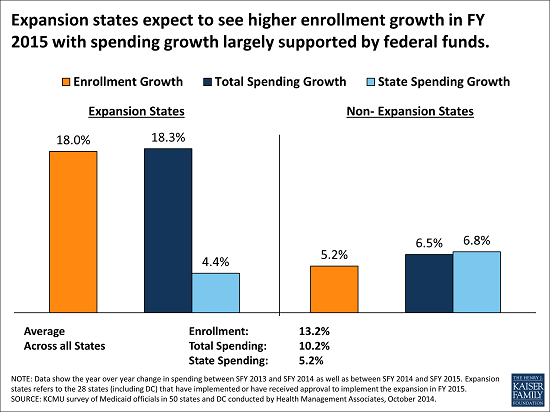
The 28 states (including the District of Columbia) implementing the Medicaid expansion for FY 2015 expect to see the largest enrollment and spending growth — an 18 percent increase in enrollment and an 18.3 percent increase in total Medicaid spending in FY 2015, on average. The spending growth is mostly driven by the boost in new enrollment that is financed by 100 percent federal funds. With the additional federal dollars, state spending in expansion states is projected to increase at a slower rate of 4.4 percent in FY 2015.
Without the coverage expansion and federal funding, the 23 states not implementing the ACA Medicaid expansion project an average 5.2 percent enrollment growth for fiscal year 2015, and project state spending to increase at a similar rate as their total Medicaid spending (6.8% and 6.5%, respectively).
http://cdn2.hubspot.net/hub/292449/file-1812253255-png/10.08.14_-_Medicaid_-_Event_and_Reports_-_Expansion_states_expect_to_see_higher_enrollment_growth_-_resized_for_the_email.png?t=1412884944994

Wednesday, October 8, 2014

Obamacare Is Making a Difference, But Here's What We Must Tackle Next

Wendell Potter

Although there is no shortage of critics of the Affordable Care Act -- on the far left as well as the right -- it's hard to dispute that the law has benefited millions of Americans. And not just those who have become newly insured over the past year.

President Barack Obama cited some of the impressive statistics last Thursday, the day after the one-year anniversary of the turbulent debut of the Obamacare-created online health insurance exchanges.

"In just the last year, we've reduced the share of uninsured Americans by 26 percent," he said. "That means one in four uninsured Americans -- about 10 million people -- have gained the financial security of health insurance in less than one year."

Approximately 8 million people were finally able to sign up for coverage on the exchanges after the many technical problems were fixed. Many others were able to enroll in health plans on private exchanges or by working directly with an insurance company or agent. As a consequence, the rate of uninsured Americans dropped from 21 percent in September 2013 to 16.3 percent this past April.

Even though open enrollment for the Obamacare exchanges ended in April, people have still been joining the ranks of the insured since then. In fact, the Congressional Budget Office estimates that the number of newly insured Americans will grow to 12 million by the end of this year.

A significant percentage of those folks were not able to find affordable coverage in the past, and many were not able to buy health insurance at any price because of insurance industry business practices that were outlawed by the ACA. Before Obamacare, insurance companies were able to declare you "uninsurable" if you had a preexisting condition, even conditions you might have been born with.

During the months that health care reform was being debated in Washington, I met many young people who told me they had not been able to buy an insurance policy because of congenital heart defects and other conditions they had had since birth.

Now they can.

That provision and other parts of Obamacare that force insurance companies to be more consumer-friendly benefit all of us, but those sections of the law are rarely mentioned these days, probably because many of them went into effect long before the exchanges were up and running. Here's a partial list:

Insurers can no longer "rescind" our policies when we get sick just to avoid paying our medical expenses;
They must allow our children to stay on our policies until they turn 26 if they can't find jobs that offer coverage;

They can't devote more than 20 percent of our premium dollars to overhead and profits;

They can no longer charge women more than men; and

They can't charge older folks more than three times as much as they charge young people for the exact same policy.

The law also benefits seniors on Medicare by closing the donut hole in the prescription drug benefit and by covering preventive care, including screenings, and it is saving the Medicare program billions of dollars by gradually reducing the extra amounts the government has been paying private insurers to participate in the Medicare Advantage program.

All that said, the law falls short in many ways. While it is reducing the rate of uninsured Americans, it doesn't get us anywhere close enough to the universal coverage that residents of other developed countries enjoy. While the ACA will cut the number of uninsured by half in the coming years, the CBO estimates that 31 million of us will still be uninsured in 2024.

Many of the newly insured are also finding that their choices of health care providers is severely limited in some of the health plans being offered on the exchanges. "Narrow networks" are not new -- they were common in the managed care plans of the 1990s -- but insurers gradually began to broaden their networks after widespread complaints. Now they're making a comeback.

The ACA also allows insurers to sell plans with very high deductibles. They can appear at first glance to be good deals because their premiums generally are lower than plans with more modest deductibles. But many people who enroll in high-deductible plans find out after they get sick or injured that they can't afford to pay their share of their medical bills. Although the ACA does put a limit on out-of-pocket expenses, it still will not prevent many insured families from filing for bankruptcy after a serious illness.

And while the law apparently is helping to keep medical costs in check, it doesn't go far enough. We still spend more per capita on health care than any other country. In that sense, I agree with my former colleagues in the insurance industry: The law doesn't do enough to address the "real cost drivers" of medical inflation. That will require taking on the hospital companies, physician organizations and drug makers in ways the White House and members of both parties in Congress were not willing to do in 2009 because of the political clout they have in Washington. Consequently, much more reform will have to be undertaken in years to come.

source

Wednesday, February 12, 2014

Highest Uninsured States Shun Health Care Reform Law

Medicaid expansion and state health exchanges are minimal in states with high rates of uninsured residents since the passage of the Affordable Care Act.

As states struggle with implementing the Affordable Care Act, a Gallup study has found that those with high uninsured rates are the least likely to expand Medicaid and establish state-based exchanges.

Texas, Arkansas, Mississippi, Florida and Louisiana are the states with the highest percentage of uninsured adult residents. Arkansas is the only state in the group to expand Medicaid and create an exchange in the health insurance marketplace, according to the Gallup-Healthways Well-Being Index for January through December 2013.

Additionally, eight of the 12 states with the highest uninsured rates do not have Medicaid expansion or their own exchange.

Nationwide, 17.3 percent of adults reported they did not have health insurance in 2013. The rate has increased from its level in 2008, 14.8 percent.

Twenty-seven percent of residents in Texas do not have health insurance, followed by 22.5 percent in Arkansas, according to Gallup. Arizona, Kentucky and North Carolina have uninsured rates of 20.4 percent. Texas continues to have the highest rate of residents without health insurance for the sixth year in a row, while Massachusetts has the lowest at 4.9 percent.

States with the lowest uninsured rates also include Hawaii (7.1 percent), Vermont (8.9 percent), Minnesota (9.5 percent) and Iowa (9.7 percent). Pennsylvania, Wisconsin and Kansas have low rates and have not expanded Medicaid or added an exchange.

Overall, 16.2 percent of adults report they lack health insurance in states that do have Medicaid expansion and state exchanges, compared to 18.7 percent of adults in states with one option or neither.

source

full Gallup report

Thursday, January 26, 2012

Insurers Profit From Health Law They Fought Against

Insurance companies spent millions of dollars trying to defeat the U.S. health-care overhaul, saying it would raise costs and disrupt coverage. Instead, profit margins at the companies widened to levels not seen since before the recession, a Bloomberg Government study shows.

Insurers led by WellPoint Inc. (WLP), the biggest by membership, recorded their highest combined quarterly net income of the past decade after the law was signed in 2010, said Peter Gosselin, the study author and senior health-care analyst for Bloomberg Government. The Standard & Poor’s 500 Managed Health-Care Index rose 36 percent in the period, four times more than the S&P 500.

“The industry that was the loudest, most persistent critic of this law, the industry whose analysts and executives predicted it would suffer immensely because of the law, has thrived,” Gosselin said. “There is a shift to government work under way that is going to represent a fundamental change in their business model.”

Health insurers contributed $86.2 million to the U.S. Chamber of Commerce to oppose the law after Obama administration officials criticized the plans for enriching themselves by raising customer premiums.

“We remain very concerned that major health-care reform provisions that go into effect on Jan. 1, 2014 will raise costs and disrupt coverage for individuals, families, seniors and small businesses,” Robert Zirkelbach, a spokesman for America’s Health Insurance Plans, the industry’s Washington lobbyist, said after reading the study.

Profit Margins

Still, the companies saw their average operating profit margins expand to 8.24 percent in the six quarters since the overhaul became law, compared with 6.88 percent for the 18 months before it was passed.

Quarterly earnings per share from continuing operations between the third quarters of 2008 and 2011 jumped 29 percent, and the results have on average beaten analyst estimates since the first quarter of 2009. WellPoint, based in Indianapolis, raised its 2011 earnings forecast in October after third-quarter earnings of $1.77 a share beat by 10 cents, the average estimate of 20 analysts surveyed by Bloomberg.

At the same time, companies are changing their business focus to gain from provisions in the law that will expand the size of Medicaid, the $401 billion government health plan for the poor. “Only by substantially reshaping their businesses can they profit,” the study says.

Health-Care Overhaul

The report compares the 18 months before and after the overhaul became law, Gosselin said. The companies studied are WellPoint; UnitedHealth Group Inc. (UNH), of Minnetonka, Minnesota; Aetna Inc. (AET), of Hartford, Connecticut; Humana Inc. (HUM), in Louisville, Kentucky; and Philadelphia-based Cigna Corp. (CI)

The managed care index (S5MANH), which includes all of the companies studied plus Coventry Health Care, rose less than 1 percent at the close in New York. WellPoint also increased less than 1 percent to $68.51.

Cynthia Michener of Aetna wouldn’t comment before reading the complete study. Declining to comment were Tyler Mason, a UnitedHealth spokesman and Phil Mann from Cigna, while WellPoint’s Jill Becher referred questions to AHIP. Humana’s Jim Turner said he wouldn’t speculate on the law’s effects ahead of a Feb. 6 earnings call.

Commercial business now accounts for less than half of the companies’ combined revenue for the first time in at least two decades, according to the study. That’s partly a result of the companies’ growing investments in plans that provide services to Medicare and Medicaid patients, the report said.

Medicare Revenue

At the same time, quarterly revenue from Medicare, the $525 billion federal health program for the elderly and disabled, increased by one third, to $16.39 billion, for the four insurers that reported figures, the study shows. Medicaid revenue more than doubled to $4.11 billion.

The companies run managed-care plans for Medicare that may see revenue rise by $10 billion by 2015 as more baby boomers retire, industry analysts have said. The insurers also administer benefits for Medicaid, which is being expanded under the health-care law starting in 2014 to cover more uninsured people. States have turned to private plans to manage Medicaid caseloads and help control health spending.

Health plans will be able to bid on an estimated $40 billion in state Medicaid contracts from now to 2014, the study found.

The top five insurers have completed at least 10 deals to add Medicare HMO’s or programs dealing with the chronically ill, which usually involve Medicare or Medicaid enrollees. The deals include UnitedHealth’s $2 billion purchase of XL Health Corp. and Cigna’s $3.8 billion for HealthSpring Inc. (HS)

The push toward government programs may prove to be a risky wager, Gosselin said in an interview.

The Supreme Court will rule on the law’s constitutionality this year and opponents of the law in Congress may target individual provisions in the overhaul for budget cuts, he said, Additionally, states may devise onerous rules for the way coverage is sold to uninsured Americans, he said.


source

Tuesday, March 31, 2009

THE COSTS OF INACTION - The Urgent Need for Health Reform

Report by the US Department of Heath and Human Services

Introduction

Americans across the country are demanding comprehensive health reform and cannot afford to wait any longer for Washington to act. Businesses and families are struggling as costs continue to skyrocket. More and more Americans find themselves uninsured. Those Americans fortunate enough to have health insurance often don't get the quality care they need and deserve. The Costs of Inaction highlights the flaws in the health care system and demonstrates the cost of maintaining the status quo. Organized into three sections - Escalating Health Care Costs, Diminishing Access to Care and Persistent Gaps in Quality - the report shows how the current system has failed millions of Americans and why we must enact comprehensive health reform this year.

Escalating Health Care Costs

Families, business, and state and federal budgets are straining under skyrocketing health care costs.

Employer-sponsored health insurance premiums have more than doubled in the last 9 years, a rate 6 times faster than cumulative wage increases.

The United States spent approximately $2.2 trillion on health care in 2007, or $7,421 per person. This comes to 16.2% of GDP, nearly twice the average of other developed nations.

Health care costs doubled from 1996 to 2006, and are projected to rise to 25% of GDP in 2025 and 49% in 2082.

The proportion of spending attributable to Medicare and Medicaid in the health system is expected to rise from 4 percent of GDP in 2007 to 19 percent of GDP in 2082, making it the principle driving force behind rising federal spending in the decades to come.

Health care costs add $1,525 to the price of every General Motors vehicle. The company spent $4.6 billion on health care in 2007, more than the cost of steel.

As a result of these crushing health care costs, American businesses are losing their ability to compete in the global marketplace. Health care at General Motors puts the company at a $5 billion disadvantage against Toyota, which spends $1,400 less on health care per vehicle.

The average cost of an employer-based family insurance policy in 2008 was $12,680, which was nearly the annual earnings of a full-time minimum wage job.

From 2000 to 2008, the percentage of employees with an annual deductible greater than $1000 increased from 1% to 18%. Among small businesses, more than one in three workers must spend at least $1000 out of pocket before their health benefits kick in.

Half of all personal bankruptcies are at least partly the result of medical expenses.

The typical elderly couple may have to save nearly $300,000 to pay for health costs not covered by Medicare alone.

Eight in ten Americans are dissatisfied with the total cost of health care, and over half report paying for the cost of a major illness as a major problem.

Diminishing Access to Care

Millions of Americans do not have health coverage, or have inadequate coverage. As our economic challenges multiply, the problem of health care access grows.

From 2000 to 2007, the proportion of non-elderly Americans covered by employer-based health insurance fell from 66% to 61%.

An estimated 87 million people - one in every three Americans under the age of 65 - were uninsured at some point in 2007 and 2008.

More than 80% of the uninsured are in working families.

Children without insurance have decreased access to well-child care, immunizations, basic dental services, and prescription medication. Uninsured adults similarly have less access to needed preventive care, and when sick, they are more likely to experience poorer health outcomes.

This in turn leads to lost workplace productivity and greater risk of illness and death, at a cost of $65 to $135 billion per year.

However, when the uninsured do obtain health care coverage, access to effective clinical services and health outcomes improve.

In the current economic crisis, even people with insurance are forgoing needed medical care, including prescription medications and doctor visits, because of inability to pay copayments and deductibles.

In the past 4 years, the number of people above 200% of the poverty line who spend more than 10% of their income on health care has more than tripled. About half of them report difficulty paying bills.

People with insurance also report difficulty accessing care when they live in areas with high uninsurance rates, and physicians in these regions believe that they cannot make medical decisions in the best interest of their patients.

Persistent Gaps in Quality

In spite of the vast resources invested, the health care system has not yet reached the goal of high-quality care.

Across 37 performance indicators, the United States achieved an overall score of 65 out of a possible 100.

Only 60% of obese adults were given advice on exercise, and just over half of children received advice on healthy eating.

Hospitals on average have still not met recommended targets for treating heart attacks in a timely manner.

If all states improved diabetes control to the level of the top four best performing states, at least 39,000 fewer patients would have been admitted for uncontrolled diabetes in 2004, potentially saving $216.7 million.

Patient safety initiatives have the potential to save thousands of lives.

Up to 98,000 Americans die each year as a result of medical errors, more than motor vehicle accidents, breast cancer, and AIDS.

The United States also lags behind other nations in the use of error-reducing techniques, such as health information technology.

Disparities in care among different subpopulations must be addressed.

Ethnic and racial minorities are often less likely to receive recommended care, as are people with lower income or lower educational status.

They are also more likely to be uninsured, more likely to leave the emergency room without being seen, and more likely to experience poor communication with their physicians.

source