Showing posts with label impact of reform. Show all posts

Wednesday, October 15, 2014

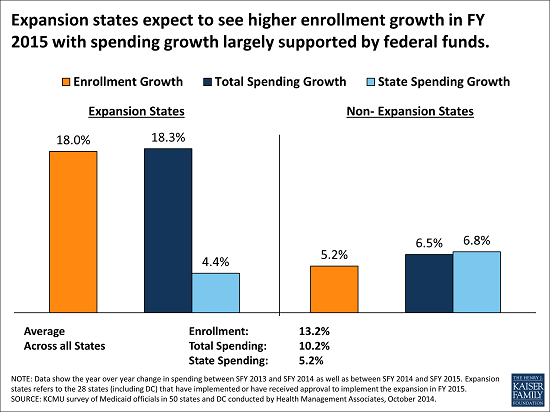
States Expanding Medicaid Under the Affordable Care Act Expect 18% Enrollment Growth in Fiscal Year 2015, With Federal Funds Picking Up Most of the Cost

The 28 states (including the District of Columbia) implementing the Medicaid expansion for FY 2015 expect to see the largest enrollment and spending growth — an 18 percent increase in enrollment and an 18.3 percent increase in total Medicaid spending in FY 2015, on average. The spending growth is mostly driven by the boost in new enrollment that is financed by 100 percent federal funds. With the additional federal dollars, state spending in expansion states is projected to increase at a slower rate of 4.4 percent in FY 2015.
Without the coverage expansion and federal funding, the 23 states not implementing the ACA Medicaid expansion project an average 5.2 percent enrollment growth for fiscal year 2015, and project state spending to increase at a similar rate as their total Medicaid spending (6.8% and 6.5%, respectively).
http://cdn2.hubspot.net/hub/292449/file-1812253255-png/10.08.14_-_Medicaid_-_Event_and_Reports_-_Expansion_states_expect_to_see_higher_enrollment_growth_-_resized_for_the_email.png?t=1412884944994

Friday, September 12, 2014

Maine Voices: Maine hospitals suffering because of state’s refusal to expand Medicaid

They’re losing money at a time when extra federal funds could support 4,400 jobs and lift the economy.

Maine’s hospitals got a financial checkup recently, and – thanks in part to some malpractice by state policymakers – the prognosis is bleak: For the 12-month period ending March 31, 2014, the hospitals collectively lost money, with an aggregate operating margin of minus 0.3 percent.

The analysis, prepared by the Maine Hospital Association for legislative candidates, also found that the number of Maine hospitals in the red for 2013 was double what it is in a typical year.
Health care is a critical component of Maine’s economy. In fact, hospitals are the largest employers in seven counties.

Part of the recent contraction could be a result of too much success. Maine’s hospitals are working hard at one of the core goals of health care reform: keeping people well with preventive and better-coordinated care, and keeping them out of the hospitals. While good for individuals and a brake on health care cost growth, fewer people in the hospital will inevitably put a dent in the bottom line for some hospitals.

But there’s more to this story.

The U.S. health care system is splitting in two. In the states that accepted federal funds to insure more low-income people through Medicaid, hospitals have received a welcome shot in the arm.

One multi-state health system, Tenet Hospital, reported that hospitals in states that expanded Medicaid have experienced across-the-board increases in patient volumes, surgeries and outpatient visits. These hospitals also saw a bump in emergency admissions – unsurprising, given that some working poor men and women have been uninsured for years and have pent-up health needs.

At the same time, uninsured admissions were halved in expansion states. This is important, because when patients cannot pay because they are uninsured, hospitals still must treat them – and the “free care” falls on the red side of hospital ledgers.

Hospitals in states that have refused federal Medicaid funds, including Maine, have received no such boost. The Robert Wood Johnson Foundation estimates that those states will squander more than $420 billion through 2022 – funds that would flow into their state economies, boosting hospital revenues and bringing thousands of health care jobs.

The Maine Center for Economic Policy estimates that the $338 million in federal funds that would be directed to Maine each year would add half a billion dollars annually to Maine’s economy and support 4,400 jobs staffing hospitals and caring for the newly insured.

Insurance coverage has increased most in states that expanded Medicaid and also set up their own marketplaces for private insurance. Among those states, the highest percentage-point improvements in coverage were in Arkansas (10.1 percent) and Kentucky (8.5 percent), while the average was 4.4 percent.

By contrast, states that didn’t expand Medicaid experienced a 2.4-percentage-point increase in coverage, largely because of the availability of more affordable private insurance coverage through health care marketplaces, whether state-run or federal. Maine, which is relying on the federal marketplace, fared slightly better, with a 2.8-percentage-point increase in coverage, partially because of coordinated enrollment efforts by a wide range of community organizations.

If Maine had expanded Medicaid in 2014, the level of coverage would have been greater. Instead, Maine’s hospitals continue to pick up the tab for treating thousands of people who would be eligible for coverage but remain uninsured because of Maine’s refusal to accept federal funds.

Experience from other states clearly shows that these funds could pay for needed care and boost operating margins at hospitals throughout Maine. Many rural counties, where the percentage of uninsured is higher than average, would benefit most from the new jobs tied to the health care funds.

While Maine’s governor resists, some of his fellow critics of the Affordable Care Act are recognizing their error. Republican Gov. Matt Mead of Wyoming, for instance, recently began meeting with federal officials to talk about what expanding Medicaid in Wyoming might look like.

“We’re handing (out) $200 million in free care just in Wyoming,” Mead said recently. “I contrast it with, I think it’s about $60 million this year that if we were in Medicaid, we would have received.” He plans to present his findings to the Wyoming Legislature when it reconvenes.

As a transformation in health care sweeps the nation, Maine is trapped in political amber, with many uninsured residents postponing care and hospitals losing money on those who do seek treatment. It’s unfortunate that, unlike Gov. Mead in Wyoming, some policymakers in Maine still won’t let the facts – and the numbers – convince them to remove their ideological blinders.

Monday, September 8, 2014

Obamacare Effect Linked to Lower Medical Cost Estimates

Estimates of U.S. health-care spending for the next five years have been lowered by two federal agencies, and the Patient Protection and Affordable Care Act is getting much of the credit.

U.S. health spending in 2019 will be $4 trillion, the Centers for Medicare and Medicaid Services said this week, or $500 billion less than the agency projected in 2010 when President Barack Obama’s health-care overhaul became law. That announcement followed by a week a report from the Congressional Budget Office lowering its five-year cost estimates.

Obamacare has been criticized by Republicans as costly and unsustainable. Now, four years after its arrival, the law’s mandated program cuts and the medical practices it encourages -- limiting unneeded procedures, and keeping people out of the hospital longer -- are cited by economists as key ingredients in trimming the nation’s medical bill. While the recession has had an influence on the cost slowdown, it doesn’t explain it all, according to policy analysts and the CBO.

“When the CBO goes back and revises their baseline, historically they’ve adjusted upwards,” said Tricia Neuman, director of the Kaiser Family Foundation’s Program on Medicare Policy. “So the fact that there’s been year-after-year downward adjustments is fairly remarkable since they occurred after the ACA” was signed into law.

While total health spending will still rise over the long run, the slower-than-expected growth predicted within the next five years has “sharply improved the nation’s fiscal outlook,” Jason Furman, chairman of the Council of Economic Advisers, wrote on the White House blog.

GDP Effect

National health-care expenditures will be 18 percent of the gross domestic product in 2019, according to the CMS report. That’s 1.5 percentage points lower than the agency’s projection in 2010 for the same year.
At the same time, the slower growth in spending is credited with prolonging the life of Medicare’s main trust fund to 2030, four years later than was projected by federal officials just a year earlier, according to a July report.

Understanding how the Affordable Care Act is contributing to the downward trend can be important for lawmakers setting health-care policies for the future, Kaiser Foundation’s Neuman said. For instance, if the hospital readmission fines that are part of the law are working to appropriately reduce unneeded procedures and saving money, that’s something they’d want to continue, according to Neuman.

Policymakers may also be encouraged to pursue similar efficiencies elsewhere in the medical system, she said.

Fresh Eye

Supporters of the Affordable Care Act known as Obamacare say that’s what the law was designed to do from the beginning: bring a fresh approach to how medical care is managed in the U.S. The defined funding cuts that offered the most direct cost savings were just one part of the law’s design.

“There’s been a lot of movement away from ‘everything you do earns you more,’” said David Cutler, an economist at Harvard University in Cambridge, Massachusetts, who was previously a senior health-care adviser for the Obama presidential campaign.

“Hospitals are being penalized for readmissions, so readmissions to hospitals are way, way down,” Cutler said in a telephone interview.

Federal payments for hospital admissions will fall $756 million next year as penalties stiffen for incidents when patients contract infections while admitted, and when patients are readmitted within 30 days, CMS said last month.

Detractors “predicted the hospital cuts would put hospitals out of business but they had it all wrong,” Cutler said. “So far we’ve seen the good effects without any of the downsides that people had worried about,” effects that “were not given credit at the time” the law was enacted.

‘Cost Effective’

“People do take the lead from their doctors,” said Paul Van de Water, a senior fellow at the Washington-based Center on Budget and Policy Priorities. “That organized medicine is finally paying more attention to whether procedures are cost-effective is very helpful.”

While many analysts agree the Affordable Care Act has contributed to lowered spending estimates, some question whether the changes can last in the long run.

Consumer discontent that they may not so easily get all the medical services they had in the past may force some services to be reintroduced, said Doug Holtz-Eakin, a former head of the CBO who now leads the American Action Forum, an advocacy group opposed to Obamacare.

“There was $700 billion in Medicare cuts,” he said in a telephone interview, referring to the Affordable Care Act’s estimated savings from 2013 to 2022. “It’s true that’s a big number in spending, but if it’s unsustainable, we’ll end up doing a U-turn.”

Recession’s Role

Another disputed point is the role that the recession played in slowing down health-care costs, as the magnitude of that factor will effect how much spending increases when the economy fully recovers.
‘The great recession had a very substantial impact on the slowdown of the rate of growth of health-care costs,’’ said Steve Bell, senior director of economic policy at the Bipartisan Policy Center in Washington. “As more and more people feel the recovery,” health-care inflation can be expected to rise, he said.
The CBO published a paper last year saying that evidence doesn’t show demand for health care by Medicare beneficiaries was diminished by the economic slump. That suggests spending in that program, at least, will likely not be affected.

Generic Medicines

One other contributing factor to the cost savings has been the increased use of less-costly generic medicines over the past five years as a wide variety of top-selling drugs, such as Pfizer Inc. (PFE:US)’s Lipitor for cholesterol control, passed their patent protection periods, according to Bell.

Now, costly new drugs such as Gilead Sciences Inc.’s $1,000-per-pill hepatitis C treatment have appeared in the marketplace, he said.

“We do see drug costs starting to increase again,” Bell said. “It’s going to be hard to deny payment for new highly expensive drugs that are coming out for some types of cancer and hepatitis C.”

About 350,000 Medicare beneficiaries have hepatitis C, according to Neuman of the Kaiser Family Foundation. If 75,000 enrollees were to be treated with Gilead’s drug, this would increase federal spending in Medicare’s outpatient prescription drug program by 8 percent, Neuman wrote in a June blog post for journal Health Affairs.

‘Big Puzzle’

“The specialty drugs are one piece of a really big puzzle,” Brian Collins, a health policy analyst who works with Bell at the Bipartisan Policy Center, said by telephone. “CBO certainly doesn’t know anything more than the rest of the world about how much that’s really going to cost.”

In the long run, the agency still expects health spending to rise significantly, especially as the U.S. population ages, so the lowered estimates in the next few years only buys short-term gains, and should not lead to complacency, the policy analysts said.

“It’s been an environment of big changes in the economy and in the law, and it’s hard to sort out what’s permanent,” Holtz-Eakin said. “Time will tell.”

source
Monday, June 30, 2014

Robert Wood Johnson Foundation makes epic changes in health funding

The Robert Wood Johnson Foundation is getting a makeover. It wants new health ideas to go viral. It wants partners in business and government to magnify its impact. And it seeks game-changing ideas from inventors to improve doctor visits and reshape medicine into a "Culture of Health."

The nation's largest health philanthrophy has long been focused on discreet health problems such as smoking and obesity. But in a major policy shift publicly discussed Wednesday for the first time, the Princeton-based foundation is seeking to up its game and inspire mass movements.

"We have to make a seismic shift in the way we deal with health, and it has to come from the ground up," said foundation CEO Risa Lavizzo-Mourey, describing the shift Wednesday at the Aspen Ideas Festival in Aspen, Co. "It's going to require that we build new partnerships, and stand on one another's shoulders so we can turn small victories into national success. That we help one another by spotlighting and supporting initiatives that are working. And by learning from those that are not."

The foundation is highly influential in health circles, giving away $400 million a year. Active multi-year grants total over $413 million in New Jersey and $128 million in Pennsylvania, including $116 million in Philadelphia.

The foundation has long been devoted to improving access to health insurance and high quality care. It is a strong backer of the Affordable Care Act, which has raised some hackles. And its leaders want to make health costs more transparent to patients.

The new approach has drawn criticism too, because it has forced cuts in long-funded areas. Its Clinical Scholars program is ending in 2017 even though it has trained doctors to be leaders for over 30 years at the University of Pennsylvania and other schools. Nursing and health policy programs are also being ended.
Health futurist Ian Morrison says the new shift is so expansive that it may be hard to measure its success. "There's a danger in dissipating the effort if you go broader," he said. "How do you know you've made a difference?"

Still, Morrison, who has worked with the foundation previously, thinks its efforts are likely to have a large influence.

Officials say the new approach is needed to make bigger, more sustainable leaps. It will need to identify new metrics. "We'll be looking for measures that are trackable and usable," said Jim Marks, Director of Program Portfolios.

In her speech, Lavizzo-Mourey, the CEO, cited the wide use of calling 911 as the kind of transformative idea the foundation is seeking.

Hundreds of humbler examples are in the works. The Flip the Clinic project is reimagining a doctor's visit to give patients more control over their care.

A model of a flipped clinic is the 11th Street Family Health Services center in Philadelphia. Since its inception in 1996, it has worked in partnership with a community advisory board composed of mostly patients. The clinic integrates mental health into primary care and tackles complex issues such as chronic pain and trauma.
"It's all based on what the community needs, rather than what insurance will pay for," said Patricia Gerrity, associate dean for community programs at Drexel University who directs the center.

Nurses often create simple yet innovative solutions. So another project, MakerNurse, seeks to harness their bedside ingenuity. "At its core, we're trying to bring makers and health together," said Jose Gomez-Marquez, director of the Little Devices Lab at MIT, which leads the MakerNurse effort.

Nurses make novel devices, such as plastic IV covers or doughnut-shaped pads for transporting babies with exposed wounds, but often don't know how to share their ideas.

Gomez-Marquez and his team are collecting data on these "MacGyver nurses" - referring to the 1990s tv inventor - and considering how they can be better supported.

Care is ultimately just one facet of health. The County Health Rankings & Roadmaps program compiles data to help communities identify areas of strengths and weaknesses involving health.

Since 2010, this program has annually assessed each county's rankings across many factors, from air and water quality, to education and tobacco use.

"There is so much that can be done upstream to prevent the need for health care," said Bridget Catlin, a senior scientist at the University of Wisconsin who directs the RWJF program.

It now provides community coaches, who are available to anyone, from a Chamber of Commerce member to a school superintendent, who wants to better their county's health outcomes.

"Almost anyone can get a movement going to build a culture of health in the community," she said. "We stand ready to help whoever shows an interest."

Clare County in Michigan ranked last in the state, according to the 2010 data. But community members got to work, targeting areas such as transporting women who need prenatal care.

The county now ranks 72nd in the state, out of 82 counties.

And, of course health needs are vast among workers. The New York City-based Vitality Institute is leading a commission to improve worker health by equipping their employers with ideas.

"Focusing more on the workplace is fundamental to promoting a culture of health," said Derek Yach, Vitality's executive director.

Its commission encourages CEOs to cover employee health information in annual reports. That emphasizes the "most important source of human capital in the company: the workforce and the health of the workforce," he said.

The institute also seeks to "harness the power and enthusiasm of companies to do the right thing," Yach said. CVS Caremark recently announced plans to stop selling tobacco products in some locations. This was met with a rise in the company's stock, an institute report noted.

Campbell Soup Company, headquartered in Camden, is also promoting community health. Working with the foundation-funded New Jersey Partnership for Healthy Kids, Campbell launched the 10-year Healthy Communities Program in 2011.

The $10 million effort first focused on the Camden area, tackling problems such as the lack of a full-service grocery store. About 40 of the 160 corner stores in Camden now have more produce and healthy food. Some even offer cooking demonstrations.. The program is expanding to include the firm's plant in Napoleon, Ohio.

"The significance of our success is reaching out to cross sector partners who share the common vision of the health of our young people," said Kim Fortunato, Campbell's director of the program.

Such partnerships are "going to make a Culture of Health happen," Lavizzo-Mourey noted in her Aspen speech. "Not me standing up here talking about it. But you, embracing the idea. Sharing it with others. And cranking up the volume on the nationwide call for change."

source

Tuesday, May 6, 2014

Deaths fell after Massachusetts healthcare overhaul: study

(Reuters Health) - When Massachusetts blazed the trail of healthcare reform in 2006 by expanding coverage for the poor and requiring all residents to have health insurance, it may have done more than serve as a model for nationwide reform: it also seemed to save lives, according to a study released on Monday.

The findings, reported in the Annals of Internal Medicine, are the first to provide a detailed analysis of the effects of systematically expanding healthcare coverage. Increasing access to Medicaid, the government-run insurance program for the poor, and mandating that everyone have health insurance were the two centerpieces of Massachusetts' healthcare reform.

They are also central to President Barack Obama's 2010 Patient Protection and Affordable Care Act, and remain its most controversial elements. Half the states have refused to expand Medicaid under the law known as Obamacare, for instance, and Republican opponents of the law regularly rail against the individual mandate requiring that individuals buy insurance or pay a penalty.


The study's authors cautioned that their analysis does not prove that Massachusetts's healthcare overhaul caused the decline in deaths; all it can show is that the two are correlated.

Previous studies that examined whether expanding access to health insurance resulted in fewer deaths got mixed results.

The new study compared deaths among people aged 20 to 64 years old in Massachusetts counties before and after "Romneycare" (as the health insurance overhaul is known, since Republican politician Mitt Romney was governor when it became law) to counties in other states.

The years compared were 2001-2005 and 2007-2010.

For every 830 people who became insured as a result of Massachusetts' mandatory coverage and Medicaid expansion, they calculated, one fewer person died each year.

That represents "a 3 percent decline in the death rate in the first few years after implementation," lead author Dr Benjamin Sommers of Harvard School of Public Health in Boston told Reuters Health.

In particular, there were fewer deaths from cancer, heart disease and infections, all of which benefit from preventive and regular healthcare, said Sommers. He has served as a senior advisor to the U.S. Department of Health and Human Services, the lead Obamacare agency, and continued to serve part-time in an advisory role in 2013-2014.

"The decline in the death rate of Massachusetts was focused in those areas where you would think reform would make the biggest difference," he said.

The drop in deaths was also larger in poorer communities that had a high number of uninsured residents before 2006.

Austin Frakt, a health economist with the Department of Veterans Affairs in Jamaica Plain, Massachusetts who was not involved in the new study but wrote an editorial accompanying it, called it "one of the most relevant studies pertaining to the Affordable Care Act."

Most such studies do show that health insurance has a positive effect on death rates and health, Frakt told Reuters Health: "Those findings are out there and the findings are really robust."

Sommers cautioned that the findings may not apply nationwide. For one thing, Massachusetts has an abundance of doctors and hospitals, many of whom accept the newly insured. Under Obamacare, people whose new insurance is not accepted by many healthcare providers might have coverage on paper but not easy access to healthcare.

The Congressional Budget Office estimates that 37 million people will gain health insurance by 2018 through the Affordable Care Act.

Annals of Internal Medicine Study

source

Thursday, March 7, 2013

Cerner, McKesson Lead Alliance to Let Doctors Share Data

Cerner Corp. (CERN) and four rival providers of electronic medical records said they will ease barriers preventing doctors and hospitals from sharing data, a potential breakthrough in the effort to get U.S. physicians to better coordinate patient care.

The five companies are forming a nonprofit group aimed at setting standards for exchanging data across their systems. Cerner, the second-biggest provider of electronic health records, joined McKesson Corp. (MCK), Athenahealth Inc. (ATHN), Allscripts Healthcare Solutions Inc. (MDRX) and Greenway Medical Technologies (GWAY) Inc. in the effort, according to a statement released today at an industry conference in New Orleans.

The agreement brings together some of the biggest providers of medical software as technology companies and hospitals face criticism for building closed systems that don’t easily share data. The Obama administration, which has set aside almost $30 billion in funding for doctors to buy digital systems, is considering new standards for the industry.

“We believe the industry needs to step up to the challenges,” Neal Patterson, chief executive officer at Kansas City, Missouri-based Cerner, said in the statement. “This alliance is about setting aside the admittedly tough politics of this issue to do what is right for the health-care consumer.”

The companies’ partnership, dubbed the CommonWell Health Alliance, will “define, promote and certify a national infrastructure with common platforms and policies.” The agreement doesn’t include the largest medical-records provider, closely held Epic Systems Corp. of Verona, Wisconsin. In their statement, the other five said the group was committed to working with all vendors.

’Fight and Die’

More open systems will “make us scrap and fight and die on the basis of transparency and innovation,” said Jonathan Bush, Athenahealth’s CEO, at a joint news conference held by the companies. “It will no longer be, ‘Hey, we can use opacity to lock people up and keep them from shopping.”’

Along with deflecting scrutiny from federal regulators, the partnership may help the companies compete with Epic, which has been extending its dominance among big, well-funded hospital systems, according to Eric Coldwell, a Robert W. Baird & Co. analyst in Chicago.

Epic’s Momentum

“Epic has a tremendous amount of momentum,” he said. Its competitors “want to make their systems easier for everybody to work with and they want to use that to their advantage in marketing pitches. They also want to help patients and help health care, but there’s a business reason to do this, too.”

Cerner rose less than 1 percent to $89.60 at the close of New York trading while San Francisco-based McKesson fell less than 1 percent to $107.39.

Athenahealth, based in Watertown, Massachusetts, fell less than 1 percent to $95.64; Allscripts, based in Chicago, slipped 1.2 percent to $12.57; and Greenway of Carrolton, Georgia, sunk 1.7 percent to $16.24.

At the same conference, Verizon Communications Inc. (VZ) announced its own bid to ease communication among physicians, saying it will start the nation’s first service enabling doctors to securely exchange medical records online.

The service will debut tomorrow following testing among about a dozen U.S. hospital systems and other clients. Under the program, medical providers who pay a monthly fee will be able to share data, texts and e-mails while still meeting U.S. privacy standards.

’Huge Savings’

Verizon, the nation’s second-biggest telephone company, generated about $5 billion of its $111 billion in total revenue in 2011 from health-related customers, said Peter Tippett, the New York-based company’s chief medical officer. It’s competing with Dallas-based AT&T, the biggest U.S. phone company, as well as cable and Internet providers for a share of the market in connecting the medical community electronically.

“The vast majority of stuff shared by providers ends up not digitizable and it’s a huge pain,” Tippett said in a telephone interview. “There’s huge savings in this. There’s a huge easing of access and care.”

Verizon will charge about $10 to $60 a month per user for doctor’s offices and hospitals to be on the system, Tippett said. The new service will consist of two components: an information exchange for hospitals to securely move data, and a web-based portal though which providers, from doctors to nurses to ambulance drivers, can exchange messages and texts.

Security Concerns

Physicians have traditionally avoided e-mail because of security concerns and data limits that often prevent them from sending large files such as X-Rays and MRIs, Tippett said. Verizon’s product, known as Secure Universal Message Services, overcomes those problems and is likely to attract “thousands” of medical providers, he said, declining to be more specific.

Verizon believes its new service will be a “game- changing” solution, Tippet said.

“We really think it will be disruptive,” he said. “It’s kind of like giving a gift of e-mail, but in a secure form, to the entire health-care ecosystem.”

The Obama administration’s records initiative makes hospitals eligible for payments of as much as $11.5 million if they can demonstrate “meaningful use” of computer system. Doctors can earn up to $44,000 in incentives over five years. Hospitals and doctors who don’t adopt electronic records by 2015 will be penalized with lower Medicare payments.

Verizon rose less than 1 percent to $47.11.

source

Monday, February 18, 2013

Hospitals promote economic role amid talk of federal cuts

A report citing the number of jobs created by hospitals is offered, as debate takes place over possible reductions in Medicare pay to those institutions.

As Congress debates ways to cut health care spending, the American Hospital Assn. wants to remind it of the contributions the health care industry, particularly hospitals, makes to the economy and how any threat to the access of health services would have a negative impact on the nation’s financial stability.
In a report issued in January, the AHA said the importance of hospitals extends far beyond health care. Hospitals are job creators, the organization said, employing nearly 5.5 million people and generating $2 trillion in annual economic activity, according to the AHA (www.aha.org/research/reports/13econimpact.shtml).

“The economic contribution of hospitals … is often critical to communities,” the AHA said in a statement.
The report said that even during a slow economy, health care continued to add jobs. In 2012, an average of 28,000 jobs per month were added, and the “ripple effect” of hospitals helped support 9.9 million jobs outside of health care, according to the report.

The AHA also said its members have provided a stable base for physicians who are struggling to adapt to a changing health system. Caroline Steinberg, vice president of trends analysis for the AHA, said she heard from many AHA members that physicians were coming to them, asking to be purchased because of a decline in patient volume, rising expenses and the uncertainty of Medicare.

More physicians in employed positions

From 2008 to 2011, the number of employed physicians, dentists, residents and interns at community hospitals grew from 199,289 to 225,771, according to AHA data. Studies have shown a majority of physicians could be in employed situations instead of independent practice by the end of 2013.

Some of the issues the AHA is concerned about include a proposed payment cap on nonemergency evaluation and management services provided at hospitals that would equal what is paid to physicians in private offices. The move would reduce Medicare spending by $1 billion a year. The AHA says hospitals already lose money treating Medicare patients in hospital outpatient departments. The proposed cap would mean a pay reduction of between 65% and 80% for 10 of the most common outpatient hospital services, the organization said.

Hospitals already took a $10.5 billion reduction in Medicare pay as a result of the sustainable growth rate patch that Congress put in place Jan. 1. That legislative action postponed until the end of 2013 a 26.5% cut to doctors’ pay rates mandated by the sustainable growth rate formula.

“Congress should not overlook the economic contribution of hospitals as it considers further deficit reduction proposals,” said AHA President and CEO Rich Umbdenstock, in a statement.

source

Friday, June 29, 2012

Health care ruling a victory, says Dignity CEO

"Life," said Lloyd Dean, CEO of Dignity Health, "is not too bad today."

Dean, a strong supporter of President Obama and a longtime advocate of universal health insurance, said Thursday's Supreme Court ruling was "a victory for patient care, and for those underserved by the health care system."

He had initially been skeptical of Obama's one-fell-swoop approach, telling The Chronicle in 2008 "some incremental steps" might be best, given the exigencies of the Great Recession. "There are not the resources available we could have hoped for," said Dean, who was on the short list to be Obama's secretary of health and human services.

Dean soon came around to the administration's thinking, but says the fight is not over. "The current law is not perfect. We need to fix the elements that people have had difficulties with." In particular, costs. "Although the act begins to bend the cost curve, we have to address how we're going to pay for what we are planning to deliver," he said.

"We have to find a way to deliver quality health care services in a cost-effective manner. That means people only be admitted to hospitals who really need to be in a hospital. That there is more focus on preventative care, that chronic conditions get treated early, before they become acute."

Dignity Health (formerly Catholic Healthcare West), headquartered in San Francisco, is the fifth-largest hospital chain in the country, with 40 full-service hospitals in California, Arizona and Nevada, and 150 ancillary clinics. It's one of 26 hospitals nationwide chosen byMedicare for a pilot program, funded by the Patient Protection and Affordable Care Act, to try to reduce the high rate of health complications and hospital readmissions (and high costs) among elderly patients.

While profitable, the company, which recorded $10.6 billion in revenue last year, is "burdened" by low reimbursements from a large number of Medicaid patients, and the low-cost or free medical services it provides, according to a Standard and Poor's report.

Reductions in Medicare reimbursements to hospitals, as provided in the act, might not make life any easier. Still, said Dean, "we supported this legislation, even though it reduces payments to hospitals, because the new delivery model it creates focuses on reducing costs by increasing the quality of care."

But, he said, "it doesn't get us off the agenda of being a more cost effective, higher quality provider of service."

"Hopefully," he added, referring to the Supreme Court's ruling, "we have enough stability and momentum to address the issues that need to be fixed."

source

Thursday, May 24, 2012

Gains in Health System Seen as Lasting by Some

The new health care law is already transforming the way care is delivered, and the changes will continue regardless of how the Supreme Court rules on the mandate for most Americans to carry health insurance, a Democratic senator and an Obama administration official said Tuesday.
The comments by the senator, Sheldon Whitehouse of Rhode Island, and the official, Dr. Richard J. Gilfillan, director of the federal Center for Medicare and Medicaid Innovation, indicated how Democrats were preparing for a Supreme Court ruling on the 2010 law. The law, which President Obama pushed through Congress on a party-line vote, promises to be a salient issue in elections for the White House and Congress this year.
Mr. Whitehouse said “there is no link, no link whatsoever,” between the insurance mandate and the work of Dr. Gilfillan’s agency, which promotes innovations in Medicare and Medicaid.
“The delivery system reforms will survive, and we should not be stalling and dawdling because we are anxious about what the court will do,” Mr. Whitehouse said at a forum held by the Center for American Progress, a research and advocacy group with close ties to the White House. “We don’t have that luxury, and I don’t think it’s a genuine risk.”
Dr. Gilfillan said, “We are confident that the law will be upheld” by the court. But in any event, he said, “the marketplace is boiling with new ideas, new opportunities,” and the private sector is seizing the opportunities.
Increasingly, Dr. Gilfillan said, private insurers are embracing ideas that Congress authorized for Medicare, like coordinating care, rewarding providers who deliver superior care and penalizing those who subject patients to needless risks.
As an example, Dr. Gilfillan cited a recent announcement by Wellmark Blue Cross and Blue Shield of Iowa and the Iowa Health System that they would team up to form an accountable care organization, intended to coordinate care and hold down costs. This collaboration is not for Medicare patients, but for 25,000 people with group or individual coverage provided by Wellmark.
Dr. Gilfillan and Senator Whitehouse said other changes in the delivery and financing of health care were gaining momentum. These include paying a fixed amount to doctors and hospitals for a bundle of services, rather than a separate fee for each service; designating a “medical home” with a primary care doctor to coordinate services for each patient; and imposing financial penalties on hospitals with large numbers of patients who are readmitted within a few weeks after they are discharged.
Mr. Whitehouse said these efforts could be contributing to a slowdown in the growth of health spending, first observed during the recent recession.
Dr. Gilfillan said “there is too much work going on for it not to be having some effect.”
But, recalling how the growth of health costs seemed to slow when President Bill Clinton tried to remake the health care system, Dr. Gilfillan said: “We saw this in the 1990s, a pause and then bang up again. We don’t want to relax.”
Republicans said the changes described by Dr. Gilfillan could speed the consolidation of hospitals, physician groups and other health care providers, increasing their ability to charge higher prices to patients and insurers.
The new law “scrambles the economics of America’s health care system in a way that reduces competition,” said Representative Lamar Smith, Republican of Texas and chairman of the House Judiciary Committee. He and other Republicans cited that as a reason for trying to repeal the law.

Friday, August 5, 2011

How Much Will Health Reform Cost? Not Much, Study Finds

The government may be picking up the tab for nearly half of the nation's health care expenses by the end of the decade, but very little of the increase will be due to the health care reform law, according to a report published Thursday in the journal Health Affairs.

Analysis from government number crunchers at the Centers for Medicare and Medicaid Services concluded that the law will help insure 30 million Americans who currently lack coverage, while increasing health costs by 0.1 percent more than what would have been expected without the overhaul.

The report from the CMS Office of the Actuary projected that health expenses will rise 5.8 percent annually over the next decade -- 1.1 percent higher than anticipated economic growth.

That kind of growth will mean the nation's total health tab will come close to $4.6 trillion in 2020, accounting for about one-fifth of the U.S. gross domestic product.

According to the report, the federal government's share of the bill is likely to increase from 27 percent in 2009 to 31 percent by 2020. Add to that expenses incurred by local governments and states, and the overall government portion of health care comes in at 49 percent, according to the report.

Even so, the study found that last year's national health spending grew at 3.9 percent -- the slowest rate ever recorded, and one that was probably due to the lingering effects of the recession. When millions of Americans lost their jobs and health insurance, they were forced to skip pricey but needed medical procedures and drugs. As the economy recovers, that rate is expected to bounce back.

In 2014, when the major coverage expansions take effect, health spending will probably surge to 8.3 percent as 30 million additional Americans gain coverage through Medicaid and private insurance plans, the report concludes. But the rate is expected to drop back to 6.2 percent in the second half of the decade as cost-control mechanisms of the reform law begin to take hold.

America's continually expanding health care costs can generally be traced to a variety of factors, including a growing and aging population, increased Medicare enrollment and expensive medical innovations.

But many of those forced to sign up for coverage under the reform law will be younger, healthy Americans who don't need the high-dollar treatments. For that reason, health insurance coverage, prescription drugs, and physician visits will likely grow in the next 10 years at a faster pace than hospital costs. Spending on prescription drugs alone is expected to increase by about 5 percentage points in 2014, to 10.7 percent. And with better access to needed drugs for preventive care, costs for expensive emergency treatments are also expected to dip.

The glowing findings surprised many, especially because CMS chief actuary Rick Foster has often questioned long-range spending projections in the past, saying that overly optimistic assumptions could prove troublesome. But at a Health Affairs briefing Wednesday, Foster told reporters, "We like to think that the reality in 2014 will be much closer to the projections."

Democrats and liberal groups warmly embraced that view Thursday.

Ron Pollack, executive director of Families USA, said he was "absolutely delighted" with the findings.

"The new report provides clear and convincing proof of the extraordinary effectiveness projected for the Affordable Care Act," he said. "When you're talking about 30 million more people receiving coverage with barely any change in health care costs, that's an extraordinary thing."

In an official White House blog post, Deputy Chief of Staff Nancy-Ann DeParle echoed the sentiment: "The bottom line from the report is clear: More Americans will get coverage and save money, and health expenditure growth will remain virtually the same."

She added that other provisions of the health reform law -- such as Accountable Care Organizations, which will aim to bring down costs by getting doctors and hospitals to coordinate care -- were not considered in the report.

"We know these new provisions will save money for the health care system, even if today's report doesn't credit these strategies with reducing costs," she wrote.

Kathryn Nix, a policy analyst with the conservative Heritage Foundation, interpreted the numbers much differently. She noted that the same CMS actuaries behind Thursday's report have warned that the cost-cutting measures embedded in the health care reform law may turn out to be unsustainable if the reform law does not move ahead as written. If planned cuts to providers go forward, for example, many doctors may stop accepting Medicare and Medicaid, and that might force lawmakers to reverse course, she said.

"This report clearly shows we're on an unsustainable trajectory in health care spending, and the health care bill didn't really do anything to change that," she said. "Once you factor in the reality that some of these cost-cutting mechanisms are unsustainable, I think you'll see that spending will increase dramatically."

source

Tuesday, July 19, 2011

For Hospitals, a Value Judgment

Healthcare reform means hospitals must focus on outcomes and not volume

Imagine running a heavily regulated business where the pressure is on improving the quality of your service while lowering prices, but your largest payers don’t even cover your costs—and they promise to pinch you even more. Add to the mix the overwhelming pressure to change your entire business model, even though it doesn’t make financial sense to do so today. And that’s only half of it. Welcome to the hospital business.

“It’s like straddling a fence and the fence is barbed wire,“ notes John Bluford, president and CEO of Truman Medical Centers, a Kansas City, Mo., hospital that provides care to a significant number of poor and uninsured patients. “You can’t afford to slip.”

The nation’s roughly 5,000 hospitals vary widely in shape, size, and mission. But front and center for hospital executives today is improving quality of patient care while simultaneously lowering costs. “It’s changing from one business model, based on volume, to a value-based one,” says Malcolm Isley, vice president for strategic services at Greenville (S.C.) Hospital System.

That is the new mantra in healthcare, one encouraged by the health reform law enacted last year. Reform reduces Medicare and Medicaid payments to hospitals—accounting for 56 percent of hospital revenues—by $155 billion this decade. In return, some 32 million people gain coverage in 2014—easing hospitals’ significant charity care loads. Reform also sets in place incentives for hospitals to coordinate patient care to keep people out of the hospital and those treated from returning to it. For hospitals, changing business models—and mind-sets—from rewarding costly, episodic hospital care to a system in which hospitals have a stake and say in what patients do before and after visiting the hospital requires having “one foot on the dock and one foot on the boat,” says Rich Umbdenstock, president and CEO of the American Hospital Association. Even with new Medicare payments that penalize hospitals when certain patients get readmitted, volume still remains the top payment method for the foreseeable future.

Nonetheless, hospitals are moving to change organizational culture, improve care quality and safety, develop care coordination acumen, and make investments in costly electronic medical records and other information technology to support value-based care. They are also partnering, working, and improving relations with physicians. Positioning for tomorrow requires dealing with the financial realities today. This includes lower patient volumes and higher levels of charity care, thanks to the economy and stubborn job market, and difficulties accessing capital.

“The big question is, can we make it to 2014?” says Bluford, who also serves as AHA chairman. That is a central question for nine of 10 hospital executives surveyed by U.S. News and Fidelity Investments (see. X). More than 90 percent of executives are concerned or extremely concerned with being able to align hospitals’ operating costs with post-reform reimbursement in the next three years. To appreciate the issues hospital executives face, one needs to look in the rear-view mirror while simultaneously peering into a crystal ball.

Moving from a volume- to value-based business model “is hard work and it became harder with the recession and its issues,” Isley says. With high unemployment, “self-pay and bad debt has increased,” he adds. While some large hospitals and health systems weathered the recession, many institutions saw revenues drop and charity care costs rise. Well after the recession ended, seven of 10 hospitals reported lower overall patient volumes and depressed volumes of elective procedures, according to the AHA.

Meanwhile, hospitals have seen privately insured patients struggle to pay their growing out-of-pocket costs, switch to public health programs with lower reimbursement, or simply lose coverage, according to the Center for Studying Health System Change. Industry operating margins ran 2 percent to 4 percent in the last decade; nearly one third of hospitals in 2009 had negative operating margins.

Hospitals responded by cutting services and overhead, reducing staff, and deferring capital projects and investments in technology, says Umbdenstock. Hospital leaders support healthcare reform but note that the law creates many challenges.

Besides health reform’s already deep Medicare and Medicaid hospital cuts, the industry is bracing for more with this summer’s deficit reduction negotiations. Meanwhile, half of the newly insured in 2014 will be on Medicaid, which covers only 89 percent of hospital costs. Reform also included Medicare’s value-based purchasing, a carrot-and-stick initiative where hospitals can earn or forfeit 1 percent of their Medicare revenues starting late next year, and 2 percent later this decade, based on each hospital’s ability to improve quality and contain costs.

A seemingly small incentive, it nonetheless has gotten the attention of hospital leaders, as a 2 percent differential from a dominant payer can mean a good or bad year. “We strive to have a 2 percent margin,” says Bluford. Commercial insurers also are likely to follow Medicare’s lead.

The movement from sickness to wellness has sparked hospital activity around so-called accountable care organizations, bundled payments, and patient-centered medical homes, concepts built on care coordination, says Steven Valentine, president of the Camden Group, a Los Angeles-based healthcare consultancy. Hospitals are racing to put in place the pieces to support a move to value, including aligning with physicians and investing in information technology.

But hospitals have no roadmap in adopting a value-based care business model. “There is no transition plan,” notes Susan Davis, president and CEO of St. Vincent’s Medical Center in Bridgeport, Conn. To prepare St. Vincent’s, Davis is cultivating a culture focused on delivering safe and reliable care. The Catholic hospital also is looking to improve care delivery and coordinating patients’ care outside the hospital by better integrating physician and hospital interests and spending $10 million on a hospital electronic medical records (or EMR) system and investing $4 million in getting medical staff technology up to par. Later this year, hospitals can earn millions of Medicare dollars based on their ability to have in place a functioning EMR that can manage, track, and coordinate patient care. “IT is critical to safety of patients and continuum of care,” Davis says.

“Doctors are the key” to value-based care, says Isley. Greenville Hospital System “transitioned to a physician-led system,” putting doctors in governance and leadership positions. GHS also is employing many of the physicians caring for its patients, which is a trend nationally. The system’s 600 employed physicians deliver 85 percent of hospital and outpatient care. Having physician and health system interests financially aligned, says Isley, should give GHS a leg up in its ability to deliver value.

Some hospitals are ahead of others. Sinai Health System in Chicago, for example, began focusing on improving community health 20 years ago. “It’s not just acute care,” says Sinai President and CEO Alan Channing, “it’s housing, education, chronic disease.” Investments and initiatives outside the hospital have helped Sinai become a top hospital nationally, based on federal quality and performance measures. “We’ve been a low-cost provider for a while,” says Channing.

Still, commercial insurers have been slow to take notice of Sinai’s ability to reduce costs and improve health. For every $1 Sinai has invested in reducing asthma-related hospital admissions—largely by improving educatihttp://www.blogger.com/img/blank.gifon in the community—it has prevented $15.57 in costs. Sixty percent of Sinai’s revenues come from Medicaid and only 5 percent from commercial carriers. “The payment mechanisms are still encounter-based,” Channing laments, worrying about “Sinai being able to make that transition while struggling to make payroll.”

Consultant Valentine says value and volume are intertwined. “To demonstrate value, you have to have volume,” he notes. Hospital consolidation will pick up, Valentine says, as providers strive to reduce per-unit costs and make investments to improve quality. One third of executives surveyed by U.S. News and Fidelity expect their hospitals will be absorbed or will absorb another in the next five years. “We believe in reform,” says Isley. “I’m optimistic on it, but there are head winds.”

source

Friday, June 3, 2011

Massachusetts health reform didn't cut ER visits

(Reuters Health) - Health care reform in Massachusetts only had a small impact on the number of trips residents took to the emergency room, according to a new study.

Contrary to expectations that easier access to primary care would reduce ER use, the total number of ER visits at 11 hospitals increased slightly after reform was implemented -- a pattern similar to that seen in other states.

"There was perhaps a perception that if we could just get people insurance they won't need the ER anymore," said Dr. Peter Smulowitz, the study's lead author from Harvard Medical School in Boston. But, "you cannot ever redirect every visitor, perhaps even the majority of visitors, away from the ER," he told Reuters Health.

Estimates have shown that the state's reform was successful in cutting its number of uninsured people by about three quarters.

Supporters of the reforms hoped that insurance would allow people to see a primary care doctor before health problems get serious enough to warrant an ER trip, with the added bonus of easing pressure on crowded emergency departments.

To assume that insuring more people will drastically cut down on the need for emergency care "is a dangerous policy choice," Smulowitz said, partly because there are many different factors that influence statewide use of ERs.

Massachusetts' health care reform required everyone in the state to have health insurance and made subsidized insurance available to residents who were uninsured or had limited coverage.

The legislation was enacted in 2006, when Mitt Romney -- now an opponent of current national health reform legislation -- was governor, and fully implemented by 2008.

Smulowitz and his colleagues used hospital billing data to compare the number of ER visits at 11 Massachusetts hospitals during nine-month periods before and after the state's individual insurance mandate was implemented in January 2008.

Total visits increased from about 425,000 in the first nine months of 2006 to 442,000 over the same period in 2008 -- a four-percent rise.

When the researchers focused in on the visits that should have been most affected by reform -- visits they classified as "low severity" in people previously uninsured or underinsured -- they found a slight dip of 2.6 percent, from 186,000 visits in 2006 to 182,000 in 2008.

By definition, most people with "low severity" visits could have been treated by a primary care doctor.

The authors note in Annals of Emergency Medicine that even with insurance, some people may have trouble accessing primary care -- for example, if they work during the day and can only get medical help at night or on the weekend. Also, primary care doctors are in limited supply, and people may have trouble booking appointments, Smulowitz added.

"Access to health care is dependent on really more than switching you over to being insured," he said.

Kathy Fuda, a former state health worker who researched emergency room use but was not involved in the current study, said policymakers may have been "overly optimistic" about health care reform's impact on ER visits.

People with insurance are the ones driving increases in ER use, she said - mainly because there are many more insured than uninsured people, at least in Massachusetts.

Fuda, now at Abt Associates, a health and policy research organization in Cambridge, Massachusetts, added that it's possible people who were previously uninsured might even use the ER more after they get insurance, if they couldn't afford to pay out-of-pocket for an ER visit before. "There are really conflicting trends there," she told Reuters Health. "It's not a completely simple picture."

The authors said that longer-term studies will be needed to see if patterns in ER use change over the years after reform. They also note that the current study couldn't look at patterns in all Massachusetts hospitals.

In terms of extrapolating to national health care reform, Smulowitz said that "the only message that one can really conclude...is that increasing access to health insurance is not going to make major changes in utilization of the emergency department."

source

Note: It might be difficult to measure the financial impact of previously uninsured being able to access care before small problems worsen and require lengthy hospital stays, but a study of the economic impact of increased reimbursements for emergency room visits on the economic health of hospitals and cost for care would help in understanding the overall picture. Another relevant statistic would be a change in the number of deaths resulting from lack of health insurance prior to reform.